

Your heart races before a work meeting. Your mind replays conversations for hours, searching for mistakes. Walking into a crowded room feels like stepping onto a stage where everyone is watching and judging. If these experiences sound familiar, you’re not alone, and learning how to manage social anxiety starts with understanding that these feelings, while intense, can be addressed with the right tools.
Social anxiety goes beyond simple shyness or occasional nervousness. It’s a persistent pattern of fear that can shrink your world, making you avoid opportunities, strain relationships, and question your own worth. The good news? Research-backed strategies exist that can help you rebuild confidence and engage more comfortably in the social situations that matter to you.
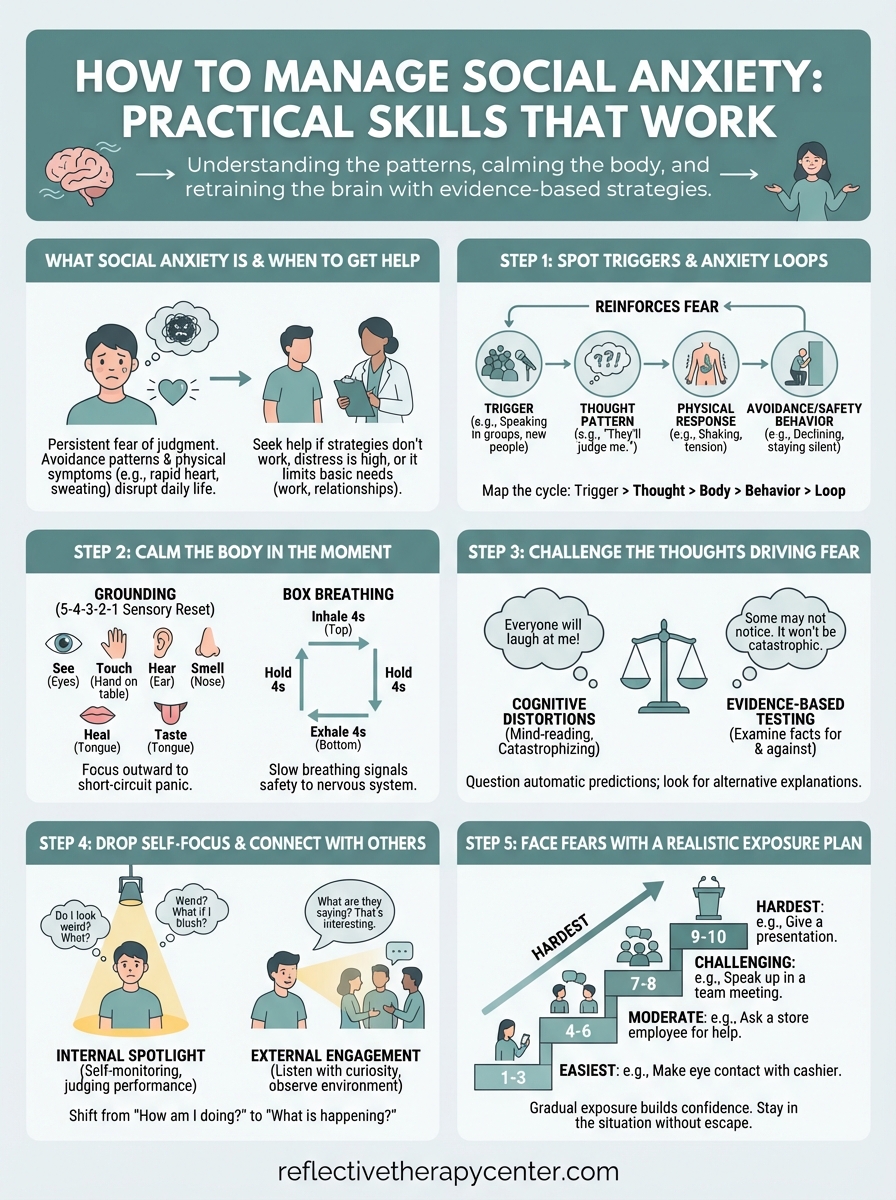
This guide walks you through practical skills that actually work, from cognitive behavioral techniques and grounding exercises to knowing when professional support might help. At Reflective Therapy Center, we’ve seen firsthand how the right combination of self-help strategies and clinical therapy can transform someone’s relationship with social situations. Whether you’re looking for tools to try on your own or considering working with a therapist, you’ll find actionable steps to start feeling more at ease.
What social anxiety is and when it needs help
Social anxiety disorder involves an intense, persistent fear of being judged, embarrassed, or humiliated in social situations. Your body interprets everyday interactions as threats, triggering the same alarm system that protects you from physical danger. This isn’t just normal nervousness before a presentation. It’s a pattern where the fear itself becomes so overwhelming that you either avoid social situations entirely or endure them with significant distress.
How social anxiety differs from everyday nerves
Everyone feels awkward or self-conscious sometimes. You might feel butterflies before speaking up in a meeting or worry about making small talk at a party. Social anxiety crosses a line when the fear is disproportionate to the actual situation and interferes with your daily functioning. Your brain predicts catastrophic outcomes (like complete humiliation) from ordinary interactions, and these predictions feel like facts rather than thoughts you can question.
The key distinction is that typical nervousness fades once you get into the situation, while social anxiety often intensifies and persists throughout the experience.
Consider these differences: nervousness might make you hesitate before approaching someone new, but social anxiety convinces you that person will definitely reject you. Nerves create temporary discomfort; social anxiety creates patterns of avoidance that shrink your world over time. You might turn down job opportunities, skip social events, or even avoid necessary tasks like making phone calls or asking questions in stores.
Signs that social anxiety is affecting your life
Recognizing when your anxiety needs attention is the first step toward learning how to manage social anxiety effectively. Your body and behavior send clear signals when the problem has grown beyond occasional discomfort.
Watch for these concrete indicators:
Physical symptoms appear regularly before or during social situations: rapid heartbeat, sweating, trembling, nausea, dizziness, or difficulty breathing
Avoidance patterns develop where you consistently skip work events, decline invitations, or find excuses to escape social commitments
Preparation rituals take over your life, spending hours rehearsing conversations or worrying about upcoming interactions
Post-event analysis consumes you, replaying every word and gesture to find mistakes or signs of rejection
Safety behaviors become necessary, like always having a friend nearby, sitting near exits, or using alcohol to cope
Life limitations appear in career advancement, relationship development, or personal goals because social situations feel impossible
When to consider professional help
You should reach out to a therapist when social anxiety disrupts your daily functioning or causes significant distress. If you’ve tried self-help strategies for several weeks without improvement, or if the anxiety has led to depression, substance use, or complete social isolation, professional support becomes essential rather than optional.
Therapy becomes particularly important when your fears prevent you from meeting basic needs (like grocery shopping or going to the doctor), damage important relationships, or create problems at work or school. Clinical interventions like cognitive behavioral therapy and exposure therapy have strong research backing, and therapists can customize these approaches to your specific triggers and goals. Some people also benefit from medication to reduce the intensity of physical symptoms while they build coping skills through therapy.
Step 1. Spot your triggers and anxiety loops
Understanding your specific triggers is the foundation of learning how to manage social anxiety effectively. Without this awareness, you’re fighting blind, reacting to every wave of panic without recognizing the patterns underneath. Your triggers create predictable loops that reinforce themselves the more you avoid them, but once you name these patterns, you gain the power to interrupt them.
Identify your specific social triggers
Social anxiety doesn’t strike randomly. Certain situations, people, or expectations activate your fear response more intensely than others. You need to track which scenarios consistently spike your anxiety so you can prepare strategies tailored to your actual challenges rather than vague worries about “all social situations.”
Start by monitoring your week and noting when anxiety surfaces. Create a simple tracking system using these categories:
Situation type: Meeting new people, speaking in groups, being observed while eating/working, making phone calls, authority figures, casual conversation
Location: Crowded rooms, one-on-one settings, workplace, social gatherings, public spaces
Relationship context: Strangers, acquaintances, close friends, romantic interests, supervisors
Performance element: Formal presentations, casual speaking up, being introduced, asking questions, disagreeing with someone
Timing: Anticipation hours before, during the event, post-event analysis phase
Map the anxiety loop pattern
Your anxiety follows a predictable cycle that strengthens each time you complete it. The loop typically starts with anticipating a trigger, moves through physical symptoms and catastrophic thoughts, leads to avoidance or safety behaviors, and ends with temporary relief that actually reinforces the fear long-term.
Breaking this cycle requires seeing how each step feeds the next, creating a self-fulfilling prophecy where your attempts to protect yourself actually maintain the problem.
Use this framework to map your personal loop:
Trigger identification: What specific situation sparks the initial worry?
Thought pattern: What predictions does your mind make? (Write the exact words)
Physical response: Which symptoms appear in your body first?
Behavioral reaction: What do you do to cope or escape?
Short-term outcome: Does the anxiety decrease temporarily?
Long-term impact: How does this response affect future situations?
Document three recent examples using this structure. You’ll likely notice that different triggers produce similar thought patterns and the same escape behaviors, revealing that you’re dealing with a learned response rather than accurate threat assessment.
Step 2. Calm the body in the moment
Your body’s physical response to social anxiety creates a feedback loop where racing heart, shallow breathing, and muscle tension convince your brain that danger is real. Learning how to manage social anxiety requires interrupt this cycle by targeting the physical symptoms directly. When you calm your nervous system, you create space to think more clearly and respond to situations rather than react from panic.
Quick grounding techniques for instant relief
Grounding techniques pull your attention away from internal panic and anchor you to the present moment through your five senses. These methods work because they engage different parts of your brain than the fear response, essentially short-circuiting the anxiety by giving your mind something concrete to focus on.
Physical grounding creates an immediate pathway out of panic by redirecting your nervous system from imagined threats to actual sensory input.
Use this five-step grounding sequence when anxiety spikes:
5-4-3-2-1 Sensory Reset
Identify 5 things you can see (blue chair, ceiling light, person’s watch, door handle, water bottle)
Touch 4 surfaces around you (table texture, fabric of your clothes, cold phone, smooth paper)
Notice 3 sounds in the environment (air conditioning hum, keyboard clicks, distant conversation)
Detect 2 scents you can smell (coffee, hand soap, fresh air, fabric softener)
Name 1 taste in your mouth (mint gum, water, coffee aftertaste, or focus on your tongue’s position)
Breathing exercises that reset your nervous system
Controlled breathing directly counteracts your body’s fight-or-flight activation by stimulating the vagus nerve and signaling safety to your brain. Shallow, rapid breathing fuels anxiety, while deliberate slow breathing shifts you into a calmer physiological state within two to three minutes.
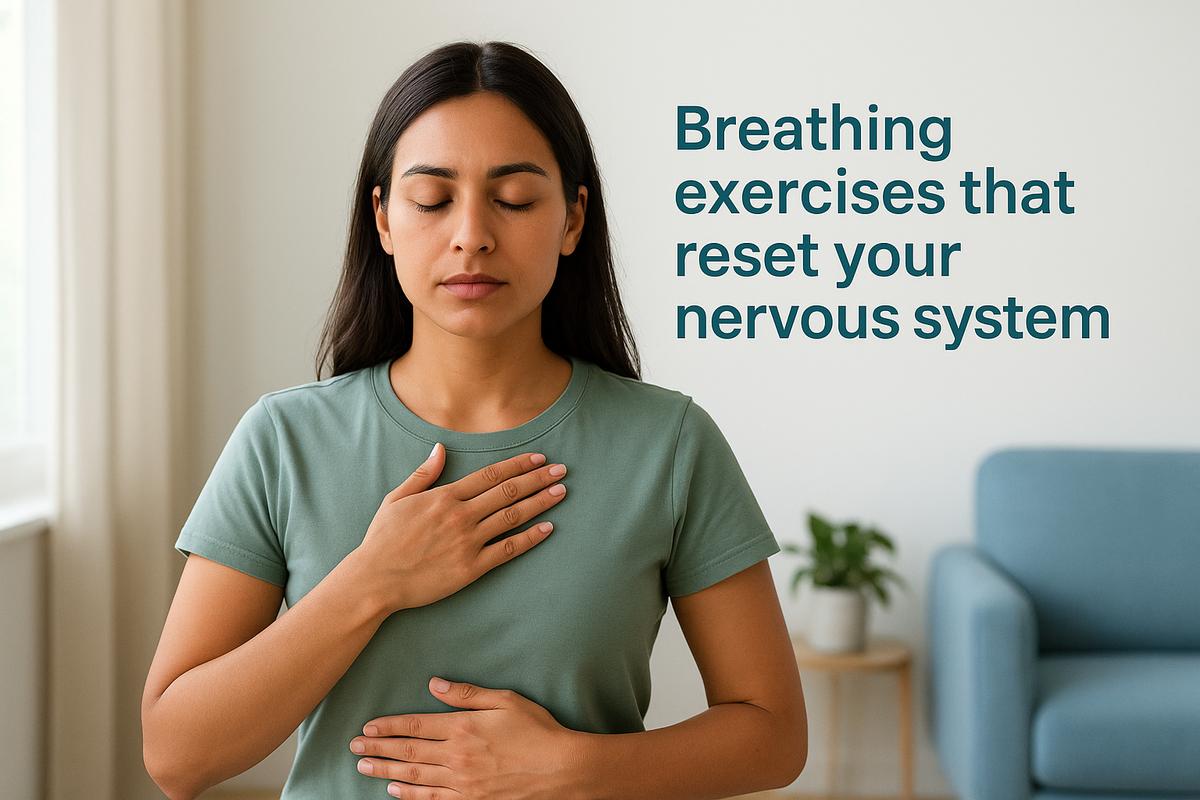
Practice box breathing before and during anxiety-triggering situations. This technique balances oxygen and carbon dioxide levels while giving your mind a simple task that prevents catastrophic thinking:
Box Breathing Pattern
Inhale slowly through your nose for 4 counts
Hold your breath for 4 counts
Exhale slowly through your mouth for 4 counts
Hold empty lungs for 4 counts
Repeat cycle 4-6 times
Execute this pattern discreetly during conversations by matching counts to internal rhythm rather than obvious counting. Your breathing will appear natural to others while you’re actively regulating your nervous system.
Step 3. Challenge the thoughts driving the fear
Your anxious thoughts feel like accurate predictions of social disaster, but they’re actually cognitive distortions that exaggerate threats and minimize your ability to cope. These mental habits include mind-reading (assuming you know what others think), catastrophizing (imagining worst-case scenarios), and all-or-nothing thinking (believing one awkward moment ruins everything). Recognizing how to manage social anxiety means questioning these automatic thoughts rather than accepting them as truth.
Catch and label cognitive distortions
Start documenting the specific thoughts that appear when your anxiety spikes. Write them exactly as they occur in your mind, not cleaned-up versions. This practice creates distance between you and the thought, letting you examine it objectively rather than being swept away by its intensity.
Most social anxiety stems from predictions about future judgment rather than actual negative feedback happening in real time.
Common distortions follow predictable patterns:
Mind-reading: “They think I’m boring” or “She noticed my hands shaking and judged me”
Fortune-telling: “I’ll definitely embarrass myself” or “This will be a complete disaster”
Catastrophizing: “If I stumble over words, I’ll lose all respect forever”
Personalization: “That person left the conversation because I’m awkward”
All-or-nothing: “I made one mistake, so the entire interaction was a failure”
Test thoughts with evidence-based questions
Challenge each anxious prediction by examining actual evidence for and against the thought. This cognitive restructuring technique forces your brain to engage its rational processes rather than staying stuck in fear mode.
Use this thought-testing template whenever anxiety tells you something catastrophic will happen:
Anxious Thought: _____________________
Evidence Supporting This Thought:
What facts prove this is true?
Has this exact outcome happened before?
Evidence Against This Thought:
What facts contradict this prediction?
What alternative explanations exist?
What would I tell a friend having this thought?
Balanced Reality Statement: _____________________
Example application: If your thought is “Everyone will notice I’m nervous and think I’m incompetent,” your evidence review might reveal that you’ve never had anyone actually comment on visible anxiety symptoms, and you regularly notice your own nervous feelings without judging others for them. Your balanced statement becomes: “I might feel nervous, and most people will be focused on their own concerns rather than analyzing my behavior.”
Step 4. Drop self-focus and connect with others
Social anxiety creates a vicious cycle of self-monitoring where you split your attention between the conversation and analyzing your own performance. You’re simultaneously trying to speak while watching yourself speak, judging how you sound, checking for physical symptoms, and predicting how others perceive you. This divided attention actually creates the awkwardness you fear because genuine connection requires your full presence.
Shift attention from internal monitoring to external engagement
Your anxious brain treats social situations like performance evaluations where you’re both the actor and the critic. This internal spotlight makes you hyperaware of every stumble, pause, or physical sensation while missing the actual social cues and content around you. Breaking this pattern means deliberately redirecting your focus outward to what’s happening rather than how you’re doing.
When you shift from “How am I coming across?” to “What is this person actually saying?” your anxiety loses its primary fuel source.
Practice these external focus techniques during conversations:
Observe specific details about the other person: their facial expressions, tone shifts, hand gestures, clothing choices
Listen for content rather than planning your next response: What information are they sharing? What emotions are underneath?
Notice the environment: Room temperature, background sounds, lighting, other people’s interactions
Track the conversation flow: How do topics naturally shift? What questions emerge organically?
Practice genuine curiosity in conversations
Anxiety tells you that protecting yourself is the priority, so you default to safe topics, brief responses, and defensive postures. Learning how to manage social anxiety includes replacing this protective stance with authentic curiosity about others. Curiosity naturally pulls your attention outward and gives conversations momentum without forced effort.
Ask questions that invite real stories rather than yes/no answers. Instead of “Did you have a good weekend?” try “What was the highlight of your weekend?” Rather than “Do you like your job?” ask “What part of your work energizes you most?” These open questions create space for the other person to share while taking pressure off you to constantly generate content.
Follow the two-question rule: After someone answers your first question, ask one follow-up that digs deeper into something they mentioned. If they say “I went hiking,” your follow-up might be “What trail did you choose?” or “How did you get into hiking?” This simple pattern demonstrates engagement, extends conversations naturally, and keeps your mental focus on them rather than your anxiety symptoms.
Step 5. Face fears with a realistic exposure plan
Avoiding situations that trigger anxiety provides temporary relief but strengthens the fear long-term by confirming your belief that you can’t handle social interactions. Exposure therapy, the most effective component of learning how to manage social anxiety, works by systematically facing feared situations in a controlled way that allows your brain to learn through experience rather than catastrophic predictions. This isn’t about forcing yourself into overwhelming scenarios but building confidence through gradual, repeated practice at your own pace.
Build a fear ladder from easiest to hardest
Create a hierarchy of situations ranked by anxiety level from 0 (no fear) to 10 (maximum panic). This fear ladder becomes your roadmap, ensuring you tackle challenges in an order that builds confidence progressively rather than overwhelming yourself with situations your nervous system isn’t ready to handle.
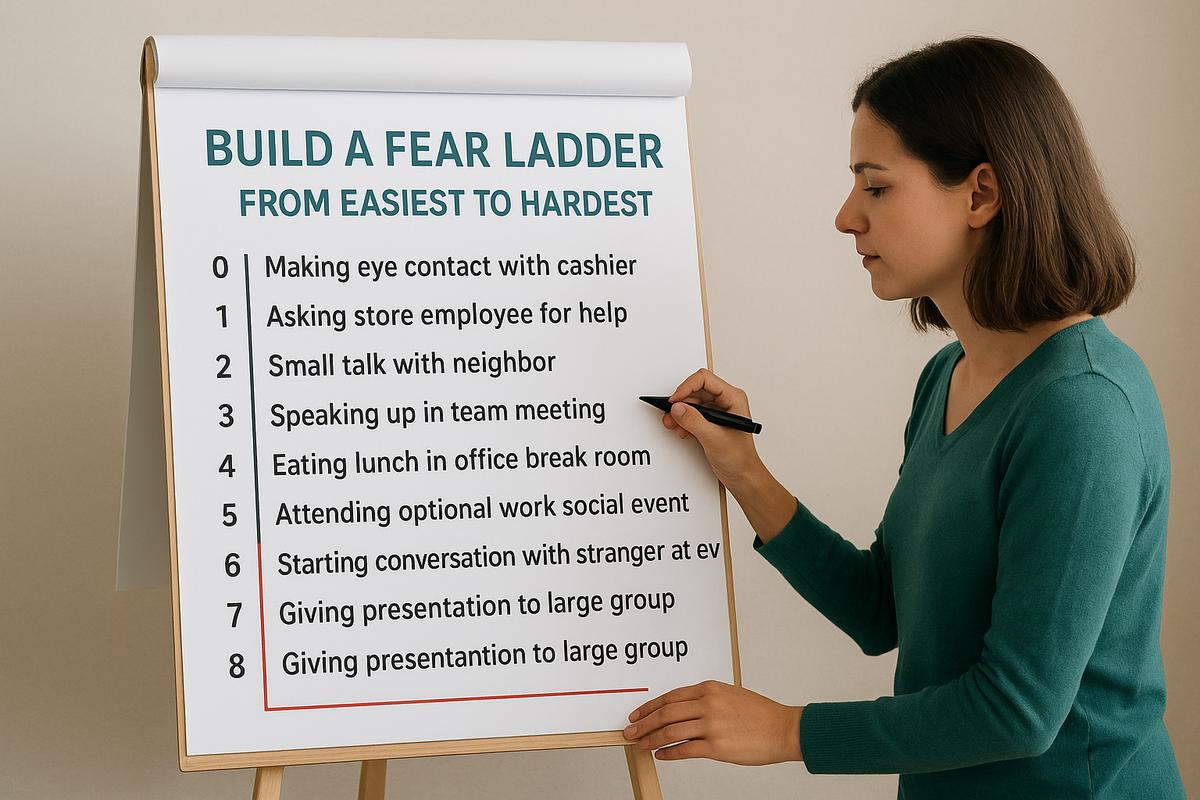
Start with situations that trigger mild discomfort rather than paralyzing fear, as success at lower levels creates momentum and evidence that contradicts your anxious predictions.
Structure your fear ladder using this format:
Example Fear Ladder Template
Practice progressive exposure without flooding
Begin with your lowest-rated item and repeat that specific situation multiple times before advancing. Your anxiety will peak initially, then naturally decrease during the exposure if you stay in the situation without using safety behaviors like looking at your phone or rehearsing scripts. Track each practice session, noting your peak anxiety level, how long it lasted, and what you learned.
Practice each fear ladder item three to five times before moving up. If a step feels too large (anxiety jumps from 4 to 8), create intermediate steps. For example, between “eating lunch in break room” and “attending work social event,” add “having coffee in break room for 10 minutes” and “attending event but leaving after 20 minutes.” Your progress pace matters less than consistent practice without retreat when discomfort surfaces.
Document your experiences after each exposure using these reflection questions: What did I fear would happen? What actually happened? What did I learn about my ability to tolerate discomfort? What evidence contradicts my anxious predictions? This post-exposure analysis helps your rational brain integrate the learning rather than letting anxiety dismiss the experience as a fluke or exception.
When self-help isn’t enough: therapy and medication
Self-help strategies provide a foundation, but sometimes the intensity of your symptoms requires professional intervention to create lasting change. You’ve reached this threshold when anxiety prevents you from meeting basic obligations, self-help attempts haven’t produced improvement after six to eight weeks, or you’re experiencing depression, panic attacks, or substance use alongside the social anxiety. Understanding how to manage social anxiety often means recognizing when expert guidance becomes necessary rather than optional.
Evidence-based therapy approaches
Cognitive behavioral therapy (CBT) remains the gold standard treatment for social anxiety disorder, with research showing 50-80% of clients experience significant improvement. Your therapist works with you to identify thought patterns, challenge cognitive distortions, and gradually face feared situations through structured exposure exercises tailored to your specific triggers. Sessions typically run weekly for 12-16 weeks, though some people benefit from longer-term support.
Acceptance and commitment therapy (ACT) offers another validated approach that focuses on changing your relationship with anxious thoughts rather than eliminating them. You learn to notice thoughts without fighting them while taking action aligned with your values despite discomfort. Some therapists combine elements from both approaches to create customized treatment plans that address your unique patterns and goals.
Professional therapy provides structured accountability and expert guidance that accelerates progress beyond what self-help alone typically achieves.
Medication options and what they treat
Selective serotonin reuptake inhibitors (SSRIs) like sertraline and paroxetine represent the first-line medication for social anxiety disorder. These medications reduce baseline anxiety levels over four to six weeks, making it easier to practice therapy skills and engage in exposure work. Your prescriber monitors side effects and adjusts dosage to find the optimal balance between symptom relief and tolerability.
Beta-blockers like propranolol treat physical symptoms specifically (racing heart, trembling, sweating) rather than the psychological aspects of anxiety. Doctors prescribe these for situational use, such as taking them an hour before presentations or performances. Benzodiazepines provide fast-acting relief but carry dependency risks with long-term use, so psychiatrists typically reserve them for short-term crisis management rather than ongoing treatment.
Next steps you can take today
Start with one grounding technique and one thought-challenging exercise from this guide. Pick your lowest-rated fear ladder item and commit to practicing it within the next 48 hours, even if you only stay in the situation for five minutes. Your brain needs repeated exposure to learn that your catastrophic predictions rarely materialize.
Track your progress in a simple notebook or phone app, recording which techniques help most and which situations feel manageable versus overwhelming. This data shows you patterns you can’t see while you’re in the anxiety itself and helps you adjust your approach based on what actually works for your nervous system.
If you’ve been struggling with social anxiety for months or years and self-help strategies haven’t created the change you need, professional support accelerates your progress significantly. Schedule a consultation at Reflective Therapy Center to work with therapists who understand how to manage social anxiety through evidence-based approaches tailored to your specific triggers and goals.