

Stress shows up differently for everyone; maybe it’s the racing thoughts that keep you awake at night, the tension headaches that appear during deadlines, or the irritability that spills into your relationships. Whatever form it takes, you’re not alone in searching for stress management techniques that actually work. The good news? Research-backed strategies exist that can help you regain calm, sharpen your focus, and finally get restful sleep.
This article breaks down ten practical approaches you can start using right away. From breathing exercises and physical movement to boundary-setting and mindfulness practices, each technique targets stress at its source, not just the symptoms. You’ll find options that fit different lifestyles, preferences, and schedules.
At Reflective Therapy Center, we work with clients every day who struggle with stress and its ripple effects on their mental health. Our therapists know that managing stress isn’t about eliminating it entirely, it’s about building skills that help you respond to it differently. Whether you’re dealing with chronic overwhelm or occasional high-pressure moments, the strategies ahead offer a solid starting point for creating lasting change.
1. Work with a therapist to build a stress plan
Professional support gives you more than just a listening ear. A therapist helps you identify patterns you can’t see on your own and builds a personalized plan that addresses your specific stressors, not generic advice. When you work with someone trained in stress management techniques, you get strategies tailored to your lifestyle, responsibilities, and mental health history.
Why this works when stress feels chronic
Chronic stress rewires your brain and body over time. Your nervous system stays in high alert mode, making it harder to relax even when the stressor is gone. Therapists use evidence-based approaches like cognitive behavioral therapy (CBT), acceptance and commitment therapy (ACT), or somatic therapy to interrupt these patterns. You learn to recognize early warning signs before stress escalates, which gives you control instead of constantly reacting.
Working with a therapist means you’re not guessing anymore about what might help. You’re following a structured approach with someone who understands how stress affects your entire system.
What to expect in therapy for stress management
Your first few sessions focus on assessment. The therapist asks about your stressors, physical symptoms, sleep quality, and coping habits to understand what’s driving your experience. From there, you collaborate on goals that might include better sleep, reduced anxiety, improved focus, or healthier boundaries. Sessions typically involve learning new skills, practicing them during the week, and adjusting the approach based on what works.
How to choose the right approach for your stress
Different therapeutic methods work for different types of stress. If your stress comes from racing thoughts and worry, CBT helps you reframe thought patterns. If trauma or past experiences fuel your stress, EMDR or trauma-focused therapy addresses the root cause. Therapists often blend approaches depending on your needs, so you don’t have to choose one method forever.
When to get extra support right away
Some stress signals require immediate attention. If you’re experiencing thoughts of self-harm, panic attacks that interfere with daily life, or stress that leads to substance use, reach out to a mental health professional now. Stress that causes chest pain, severe insomnia, or drastic mood changes also warrants urgent care. These symptoms tell you your body and mind need more support than self-help strategies can provide.
2. Use diaphragmatic breathing to downshift fast
Diaphragmatic breathing activates your body’s natural relaxation response in minutes. Unlike shallow chest breathing that often accompanies stress, this technique engages your diaphragm to signal your nervous system that it’s safe to calm down. You can use it anywhere without special equipment or privacy.

How slow breathing changes your stress response
When you breathe deeply into your belly, your vagus nerve sends signals to reduce heart rate and lower cortisol levels. This physiological shift moves you from fight-or-flight mode into a rest-and-digest state, which is why breathing exercises appear in nearly every list of stress management techniques. Your body responds within 60 to 90 seconds of focused breathing.
Controlled breathing works because it’s one of the few automatic body functions you can consciously influence to change your stress state.
A simple step-by-step breathing pattern to try
Place one hand on your chest and one on your belly. Breathe in slowly through your nose for four counts, letting your belly rise while your chest stays relatively still. Hold for four counts, then exhale through your mouth for six counts. Repeat this cycle for three to five minutes. The longer exhale activates your parasympathetic nervous system more effectively than equal inhales and exhales.
Best moments to use it for calm and focus
Use this technique before stressful meetings, during work breaks, or when you notice tension building. It works especially well right before bed to transition your body toward sleep. Many people also use it during commutes or while waiting in lines to prevent stress from accumulating throughout the day.
Common mistakes that make breathing feel harder
Forcing your breath creates more tension instead of less. Let the rhythm feel natural rather than rigidly timing each second. Avoid breathing too deeply or too quickly, which can cause lightheadedness or increase anxiety. If you feel dizzy, return to normal breathing and try again with gentler, smaller breaths.
3. Release tension with progressive muscle relaxation
Progressive muscle relaxation (PMR) systematically releases physical tension by having you tense and then relax muscle groups throughout your body. This contrast helps you notice where you hold stress and teaches your body what true relaxation feels like. You can complete a full cycle in 10 to 15 minutes, making it one of the most accessible stress management techniques for both beginners and experienced practitioners.
Why muscle tension keeps stress “on”
Your muscles tighten during stress as part of your body’s protective response, preparing you to fight or flee. When stress becomes chronic, those muscles never fully release, creating a feedback loop where physical tension signals your brain that danger still exists. This perpetual tightness contributes to headaches, jaw pain, back problems, and difficulty sleeping.
Releasing physical tension breaks the cycle by sending your brain the message that the threat has passed.
A quick head-to-toe routine you can follow
Start by tensing your facial muscles for five seconds, then release for 10 seconds. Move down through your neck, shoulders, arms, hands, chest, stomach, buttocks, thighs, calves, and feet, following the same pattern. Focus on the difference between tension and relaxation rather than forcing the process. You’ll notice sensations like warmth, tingling, or heaviness as each muscle group lets go.
How to use it for sleep and middle-of-the-night wakeups
Practice PMR while lying in bed to transition your body toward sleep. If you wake during the night, start with your jaw and shoulders since those areas often hold the most tension. The rhythmic nature of tensing and releasing also gives your mind something to focus on besides racing thoughts or worries.
Who should modify this technique
People with muscle injuries, chronic pain conditions, or recent surgeries should skip tensing and focus only on breathing into each body area while imagining tension melting away. If you have high blood pressure or heart conditions, consult your doctor before adding muscle tensing to your routine.
4. Ground yourself with the 3-3-3 rule
The 3-3-3 rule pulls you out of anxious spirals by redirecting your attention to physical sensations in your immediate environment. This sensory grounding technique interrupts the stress response within seconds by giving your mind a concrete task instead of feeding worry loops. You don’t need preparation or privacy to use it.

What grounding does in the moment
Grounding shifts your focus from internal stress to external reality. When anxiety takes over, your brain fixates on threats that might happen, which keeps your body in high alert mode. By naming what you see, hear, and feel right now, you anchor yourself in the present moment where those threats don’t exist. This sensory awareness activates different neural pathways than worry, effectively breaking the cycle.
Grounding works because it replaces abstract fears with concrete observations your brain can process without triggering alarm.
How to do the 3-3-3 rule step by step
Name three things you see around you, like a doorframe, a coffee cup, or a crack in the ceiling. Then name three sounds you hear, whether it’s traffic outside, the hum of a refrigerator, or someone typing. Finally, move three parts of your body, such as wiggling your toes, rolling your shoulders, or stretching your fingers. The sequence matters less than completing all three sensory categories.
When grounding works better than “thinking it through”
Use grounding when logical thinking makes stress worse or when you feel disconnected from your body. Panic attacks, dissociation, or moments when worry spirals out of control respond better to sensory techniques than cognitive strategies. Grounding doesn’t require you to understand or solve the problem.
Variations if you’re in public or at work
You can do this silently without drawing attention. Notice the texture of your clothing, the temperature of your hands, or the feeling of your feet on the floor. Count colors instead of naming objects if you’re in a meeting or conversation where speaking aloud would be disruptive.
5. Move your body with rhythmic exercise
Physical activity rewires your stress response by burning off cortisol and adrenaline while releasing endorphins that improve mood. Rhythmic movement like walking, swimming, or cycling creates a meditative state that quiets anxious thoughts while your body works. Unlike high-intensity workouts that can sometimes increase stress, gentle repetitive motion calms your nervous system while still providing the chemical benefits that make exercise one of the most effective stress management techniques.
How movement lowers stress hormones and boosts mood
Exercise reduces cortisol levels within 20 to 30 minutes while simultaneously increasing endorphins and serotonin. Your brain also produces brain-derived neurotrophic factor (BDNF), a protein that repairs stress damage to neurons and improves cognitive function. The rhythmic nature of activities like jogging or rowing gives your mind something to focus on besides worry.
Movement changes your brain chemistry in ways that talk therapy and breathing exercises cannot replicate alone.
Easy options when you have low energy
Start with a 10-minute walk around your neighborhood or office building. Dancing to three songs in your living room counts as exercise and takes less than 15 minutes. Gentle yoga, stretching routines, or slow swimming laps work when high-intensity options feel impossible.
How much exercise you need for stress relief
Research shows that 150 minutes per week of moderate activity provides maximum stress benefits, but you’ll notice improvements with as little as 20 to 30 minutes three times per week. Breaking it into smaller chunks throughout the day works just as well as single longer sessions.
How to stay consistent without burnout
Choose activities you actually enjoy rather than forcing yourself through workouts you hate. Schedule movement at the same time each day to build a habit instead of relying on motivation that disappears during stressful periods.
6. Protect your time with boundaries and time blocking
Saying yes to everything creates a schedule where stress management techniques can’t even fit. When you overcommit, you’re constantly reacting to other people’s priorities instead of protecting space for what actually matters to you. Time blocking and boundary setting give you control over your calendar, which directly reduces the feeling of being overwhelmed and rushed.

How time pressure turns into constant stress
Every commitment you make without evaluating its true cost steals time from rest, exercise, relationships, and sleep. Your nervous system interprets chronic time pressure as a threat, keeping cortisol elevated throughout the day. This pattern explains why busy people often feel exhausted even when they haven’t done physical labor.
Protecting your time isn’t selfish, it’s how you create space for the activities that actually lower stress.
A practical way to map your day in blocks
Assign specific tasks to fixed time slots instead of working from an endless to-do list. Block 90-minute chunks for focused work, 30 minutes for email, and 15-minute buffers between meetings to prevent one obligation from bleeding into the next. Include blocks for movement, meals, and transition time.
Scripts for saying no and asking for what you need
Use phrases like “I don’t have capacity for that right now” or “Let me check my schedule and get back to you” instead of immediate yeses. When asking for help, try “I need support with X because I’m at my limit” rather than apologizing for needing assistance.
How to handle guilt, perfectionism, and people-pleasing
Guilt appears when you change patterns that others have grown comfortable with. Remind yourself that protecting your time allows you to show up better for the commitments you do keep. Perfectionism thrives on overcommitment since you can’t do everything well when you’re doing too much.
7. Use social support as a real stress buffer
Strong relationships protect you from stress in ways that other stress management techniques cannot replicate alone. When you have people who listen without judgment, your body responds differently to challenges compared to when you face them isolated. Social connection isn’t just about feeling better emotionally; it changes your physiological stress response in measurable ways.
Why connection changes your stress response
Talking to someone you trust lowers cortisol and activates oxytocin, which counteracts the effects of stress hormones. Your nervous system interprets social support as safety, allowing you to downshift from high alert mode. Studies show that people with strong social networks recover faster from stressful events and experience fewer stress-related health problems over time.
Connection literally changes your brain chemistry in ways that help you handle pressure.
What to say when you do not know how to ask for help
Start with simple statements like “I’m having a hard time and could use someone to talk to” or “Can I vent for a few minutes?” Being specific helps others understand what you need: “I’m stressed about work and need advice” differs from “I just need to complain without getting solutions.” Most people want to help but don’t know how unless you tell them.
How to build support if you feel isolated
Join groups centered on activities you already enjoy rather than networking events. Community classes, volunteer opportunities, or hobby groups create natural connections without the pressure of forced socializing. Online communities work when in-person options feel overwhelming, though face-to-face interaction provides stronger stress relief benefits.
Red flags in relationships that increase stress
Relationships that consistently drain more than they give add to your stress load. Watch for patterns where people dismiss your feelings, create drama, or make everything about themselves. Protecting yourself from toxic relationships matters as much as building supportive ones.
8. Reframe stressful thoughts with CBT-style tools
Your thoughts about a situation create more stress than the situation itself in many cases. Cognitive behavioral therapy (CBT) teaches you to identify distorted thinking patterns and replace them with more balanced perspectives. This approach gives you control over the mental spiral that turns minor problems into major sources of anxiety.
How thoughts amplify stress even when nothing changes
Your brain treats imagined threats the same way it treats real ones, flooding your system with cortisol and adrenaline based on what you think might happen. When you tell yourself “I’ll definitely fail” or “Everyone will judge me,” your body responds as if those outcomes are already occurring. This mental amplification explains why two people in identical situations experience completely different stress levels.
Changing your thoughts doesn’t eliminate the problem, but it stops you from creating additional stress on top of what already exists.
A simple reframe process you can do on paper
Write down the stressful thought exactly as it appears in your head. Next, list evidence that supports it and evidence that contradicts it without judgment. Finally, write a more balanced thought that accounts for both sides. For example, “I’m terrible at presentations” becomes “Presentations make me nervous, but I’ve successfully completed them before and can prepare to improve.”
How to handle catastrophizing and worst-case spirals
Catastrophizing takes one negative possibility and treats it as inevitable. Ask yourself “What’s the actual worst outcome, the best outcome, and the most likely outcome?” Writing all three scenarios shows your brain that disaster isn’t guaranteed.
When reframing is not enough on its own
Reframing works best for everyday stress and worry, but it doesn’t replace professional help for trauma, severe anxiety, or depression. If your thoughts include self-harm or feel completely uncontrollable, working with a therapist provides stronger support than cognitive techniques alone.
9. Journal to process stress and spot patterns
Writing down your thoughts creates distance between you and your stress in ways that thinking alone cannot achieve. Journaling gives you a record of patterns you’d otherwise forget, showing you which situations trigger the same reactions repeatedly. Among stress management techniques, this one costs nothing and requires no special skills beyond putting pen to paper.
What journaling helps you notice that you miss in the moment
Your brain processes stress faster than you can consciously track during high-pressure moments. Later, when you write about what happened, you spot triggers, thought patterns, and physical symptoms that vanished from awareness while you were caught in the experience. This hindsight reveals whether stress comes from specific people, times of day, or types of tasks.
Writing creates clarity that thinking in circles never produces.
Prompts for stress, worry, and decision fatigue
Try “What’s taking up the most mental space right now?” or “What would I do if this worry wasn’t controlling me?” For decision fatigue, write “What am I avoiding deciding and why?” Simple prompts work better than elaborate systems that add more pressure to your day.
How to use journaling to prevent repeat stress cycles
Review entries once per week to identify recurring themes. If the same problem appears three times, you need a strategy instead of more venting. Track what helped versus what made things worse to build your personal stress response playbook.
How to avoid journaling that turns into rumination
Set a timer for 10 to 15 minutes to prevent endless dwelling. End each entry with one action you can take instead of leaving yourself stuck in the problem. Skip journaling altogether if it increases anxiety rather than releasing it.
10. Build a wind-down routine that improves sleep
Poor sleep makes stress worse, and stress destroys sleep, creating a cycle that leaves you exhausted and overwhelmed. A consistent wind-down routine signals your body that it’s time to transition from alertness to rest, making it one of the most overlooked stress management techniques. You need a sequence of calming activities that prepares your nervous system for sleep instead of expecting your brain to switch off instantly.
How stress disrupts sleep and how sleep lowers stress
Cortisol keeps you wired when it should naturally drop at night, making it harder to fall asleep even when you’re physically exhausted. Stress also causes frequent waking because your brain stays in threat-detection mode rather than allowing deep restorative cycles. Meanwhile, quality sleep reduces cortisol production, improves emotional regulation, and strengthens your ability to handle pressure the next day.
Sleep acts as a reset button for your stress response system when you give it the right conditions.
A 30-minute wind-down routine that actually feels doable
Start your routine at the same time each night to train your body’s internal clock. Spend 10 minutes dimming lights and tidying small messes that would nag at you in bed. Use the next 10 minutes for gentle stretching or progressive muscle relaxation. Finish with 10 minutes of reading something calming or journaling about three things that went well that day.
What to change with caffeine, alcohol, screens, and naps
Stop caffeine intake by 2 p.m. since it stays in your system for six to eight hours. Alcohol might make you drowsy but disrupts deep sleep cycles, so limit it to earlier in the evening or skip it entirely. Put screens away 60 minutes before bed because blue light suppresses melatonin production.
What to do if stress keeps waking you up at night
Don’t lie in bed forcing yourself back to sleep for more than 20 minutes. Get up, move to another room, and do something calm like reading until you feel drowsy again. Practice the 3-3-3 grounding technique or diaphragmatic breathing to interrupt the stress spiral that woke you.
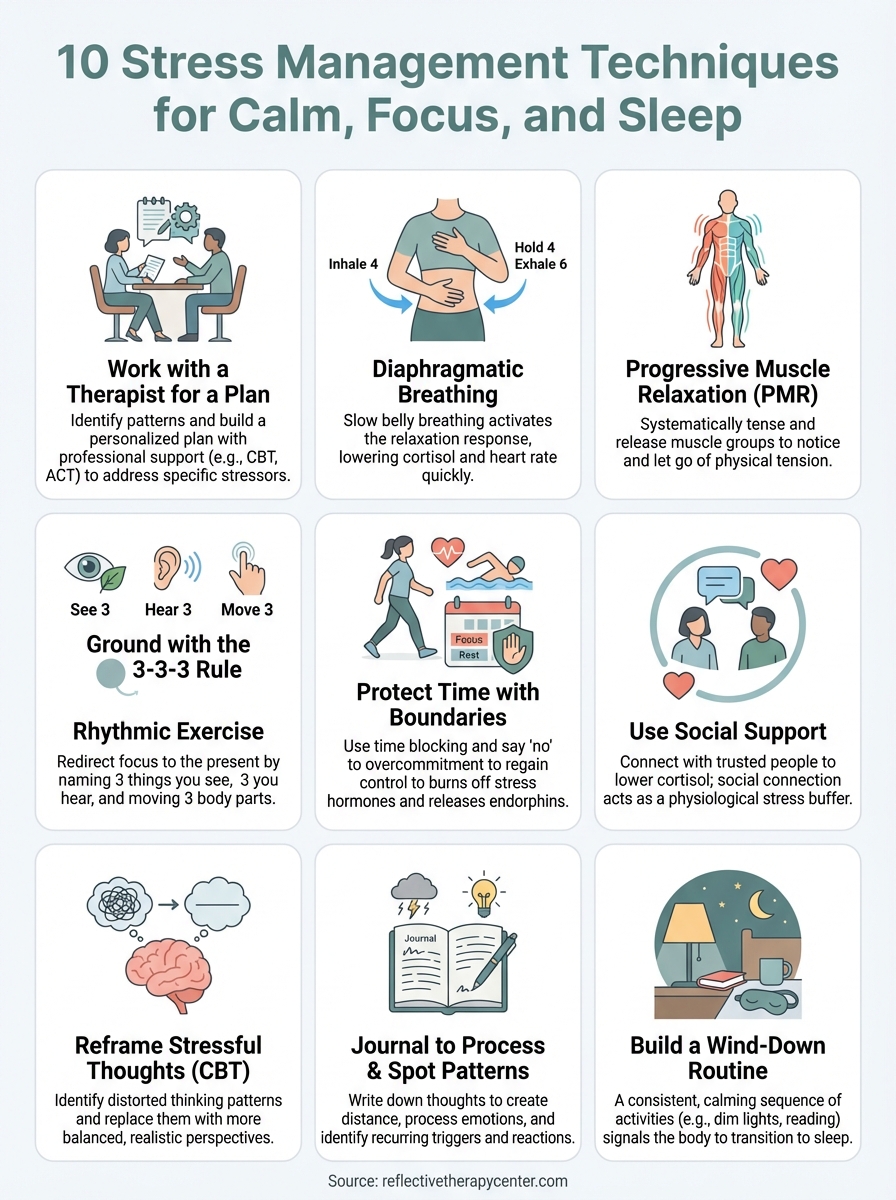
A calmer week starts with one change
You don’t need to master all ten stress management techniques at once to see results. Pick one approach that fits your current situation and commit to using it consistently for the next seven days. Maybe you’ll start with diaphragmatic breathing during work breaks, or you’ll block 30 minutes each evening for a wind-down routine. Small, repeated actions create bigger shifts than occasional perfect efforts.
Track what changes when you stick with your chosen technique. Notice if you fall asleep faster, feel less irritable, or handle unexpected problems with more calm. These observations tell you whether to continue with your current approach or try a different one from the list.
If stress feels overwhelming even after trying these strategies, working with a professional provides structure and accountability that self-help alone can’t match. The therapists at Reflective Therapy Center help you build a personalized stress plan that addresses your specific triggers and symptoms.